
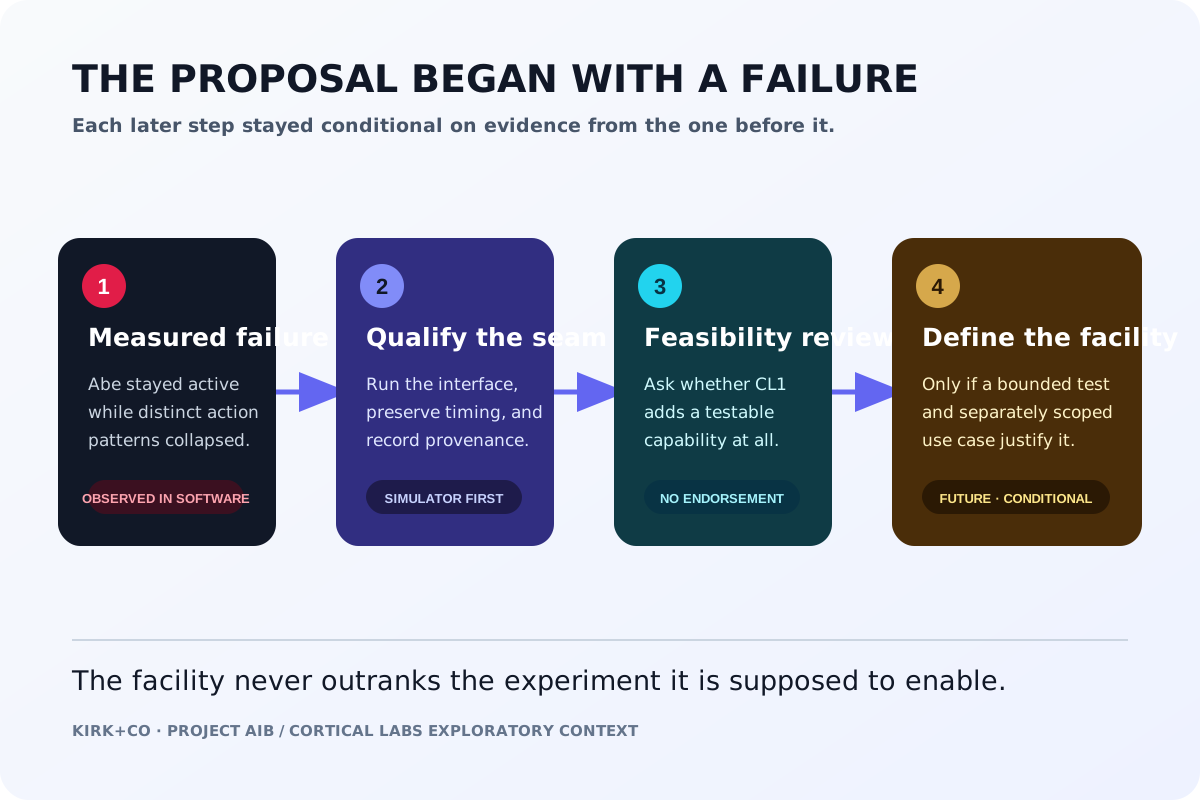
Abe could move. That was not the problem.
Project AIB had already connected a simulated infant body to a developmental software neural system. The body could execute different motor commands. The network remained active and plastic. But under training, the internal patterns responsible for choosing among actions could lose their separation. The system was still doing something while becoming less reliable about which thing to do.
That failure changed the question. We were no longer asking only how to improve the software. We were asking whether the missing capability was a mistake in our model, a limit of the architecture, or something living neural tissue might help us study before we understood how to reproduce it.
Why Cortical Labs entered the picture
Cortical Labs’ CL1 platform combines cultured neurons with a digital interface for stimulation, recording, and closed-loop experimentation.[1] That did not make CL1 an automatic answer. It made the comparison testable.
In August 2026, Kirk+Co held an exploratory technical discussion with Cortical Labs. After that discussion, Kirk+Co narrowed the proposed technical review artifact: keep Abe’s body, nursery, clocks, safety controls, and analysis in software; reduce the behavioral task to a small set of legible actions; and ask whether a living adaptive substrate could produce a repeatable learning signal that the current software baseline did not.
The conversation earned permission to submit a bounded technical artifact for feasibility review. It did not create a partnership, commit Cortical capacity, approve a biological experiment, or endorse a Tennessee facility.
That distinction matters. Cortical’s platform was a candidate instrument in the investigation—not borrowed proof that the thesis was right.
The laboratory idea came second
Separately, Tennessee’s public nuclear-innovation activity raised a longer-term question about where disciplined instrumentation and qualification capabilities might eventually matter.
The Department of Energy and the State of Tennessee were publicly exploring Nuclear Lifecycle Innovation Campus concepts around Oak Ridge, with potential roles for advanced manufacturing, power, data infrastructure, and private-sector technical partners.[2][3] That public process did not award Kirk+Co or Cortical Labs anything. It made Tennessee a credible place to ask what a disciplined validation capability might eventually serve.
That industrial question remained separate from the AIB/CL1 experiment. No Tennessee company commissioned or sponsored this work, and no nuclear application had been defined. A validated learning effect would still need its own requirements, safety case, and domain owners before anyone could responsibly connect it to a facility or operating environment.
Why write a lab proposal before there is a lab?
Because the expensive mistake would be to start with rooms and equipment.
A frontier-research facility can become an equipment catalog with a thesis hidden inside it. The names sound ambitious. The purchasing decisions remain difficult to evaluate. By the time someone asks what a device actually lets the team learn, too much money and identity may already be attached to the answer.
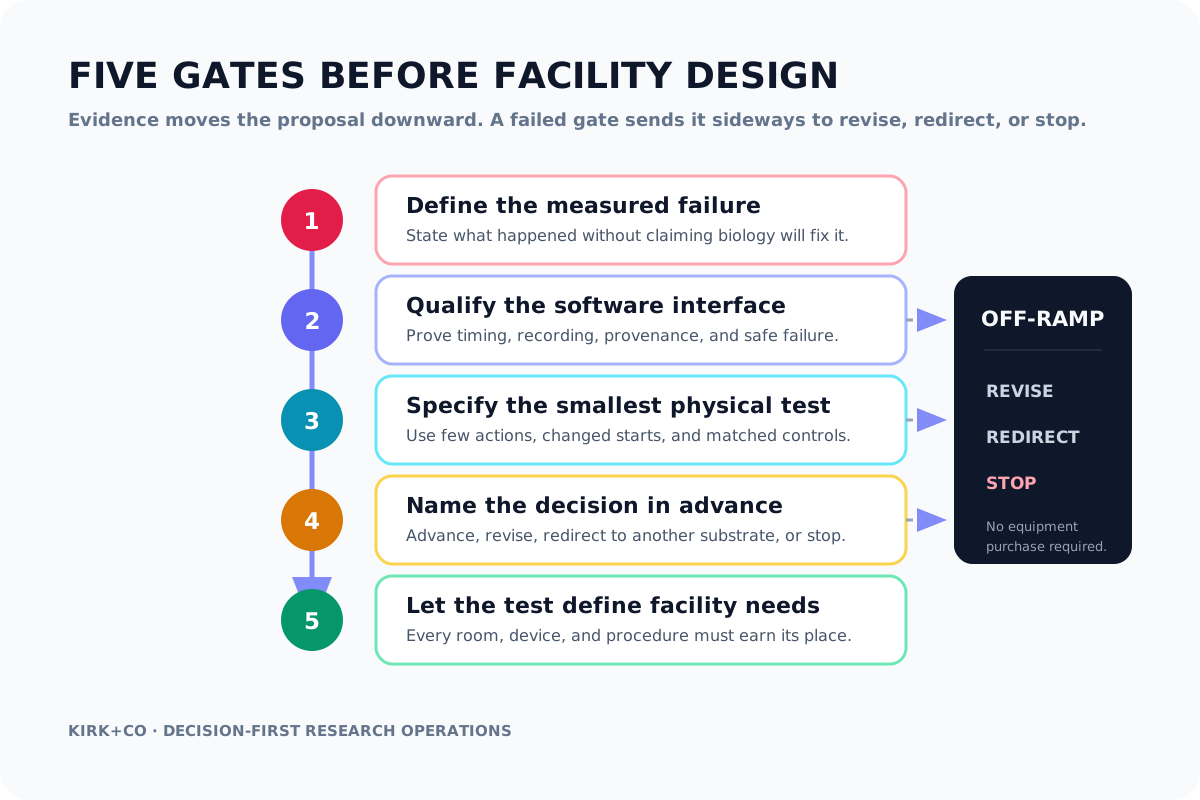
The proposal took the opposite route. It began with a sequence of gates:
- Define the failure. Abe’s action-selection problem had to be stated without claiming that biology would solve it.
- Qualify the interface in software. The Cortical SDK path had to run, record events, preserve timing and provenance, and fail safely before scarce biological capacity was requested.
- Specify the smallest physical test. A few coordinated actions, contingent feedback, changed starting conditions, and controls against persistence or random success.
- Name the decision. Advance, revise, redirect to another substrate, or stop.
- Only then define facility needs. Space, equipment, people, safety, data, and operating procedures had to earn their place by enabling a specific experiment or qualification decision.
If a line item cannot answer “what does this let us test?”, it has not earned its place in the proposal.
What the proposal became
The resulting artifact was not a laboratory design. It was a proposal architecture:
- the research rationale connecting Abe’s measured failure to a cross-substrate question;
- a capability map tying each proposed resource to an experiment;
- a staged decision framework that keeps simulator work ahead of biological access;
- a dependency register covering equipment, space, data, people, safety, and procedures;
- an expert-question queue for the claims Kirk+Co could not responsibly settle alone;
- and a stop path if CL1 or another neuromorphic substrate failed to justify further investigation.
What exists—and what does not
The software-side proposal and review artifacts became concrete enough to support technical criticism. The laboratory remained conditional.
There is no completed neuromorphic facility, approved funding, final site, equipment order, biological result, Cortical partnership, committed Tennessee company, or nuclear deployment. There is a more defensible chain of questions than we had at the beginning.
Abe exposed a failure. Cortical Labs offered to assess whether CL1—or another neuromorphic substrate—might fit the question. Tennessee’s public nuclear activity raised a separate, later question about where a validated capability might matter. The proposal’s job was to keep those lanes separate until evidence justified connecting them.
Qualified specialists still own the scientific, biological, facilities, safety, procurement, and nuclear-domain judgments. Kirk+Co’s contribution is to make the uncertainty inspectable before ambition turns it into concrete.
Sources
[1] https://corticallabs.com/cl1.html — Cortical Labs — CL1 [2] https://www.energy.gov/articles/department-energy-seeks-hosts-nuclear-lifecycle-innovation-campuses — U.S. Department of Energy — Nuclear Lifecycle Innovation Campuses [3] https://www.tn.gov/governor/priorities/governor-response-to-doe-rfi.html — State of Tennessee — Response to DOE NLIC RFI
← Back to News